Archive for the ‘Geograph’ Category

Geograph Mashup Challenge

Saturday, February 27th, 2010

We are pleased to announce a developer challenge to build a cool Mashup using Geograph Data/Photos. The closing date for entries is 11pm 31st March 2010.

The first prize is a Space Navigator, with 5 runner up prizes of a Geograph key ring!
Judging will be by a panel of judges and possibly a user vote on a the Challenge showcase web site (TBA).

The rules are simple:

  • Create a web site, mobile, or desktop application (or similar) that uses Geograph data
  • The application must be available for free
  • Of course free to mashup the information with other sources (in fact its encouraged!)
  • Welcome to submit multiple distinct mashups – but each needs to be substantially different.

Other than let your imagination and ingenuity run wild.

Geograph will provide to all entrants:

  • Live API to search/download Photo data – includes hosting for thumbnails only
    • (includes bespoke development at Developers discretion – will try to provide to all that ask within resource constraints)
  • Static Dumps of pretty much the whole Geograph Database (mysql format)
  • Torrent Downloads of a sample of 250,000 images
  • Potentially help with hosting if you don’t have available (please ask!)
  • All confirmed mashups will be showcased/linked on the Challange Website.

This is for Geograph British Isles, but if can incorporate Geograph Germany data too, all the better – what data is available may vary.

For inspiration, offer up my pithy attempt:
Geograph Photos on a OpenSpace Map

Entry Form!

(note this is not sponsored by 3dconnexion – its entirely Geograph run)

Faceted browsing of Geograph images in Flamenco!

Saturday, January 16th, 2010

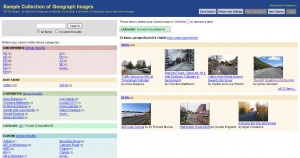
Totally accidently, via a recent Ask-Slashdot post looking for a Search Engine interface, happened across Flamenco search interface framework. It didn’t suit the asker, but its pretty close to great for Geograph, which has lots of categorization. I’ve been looking to build something like this, and have been slowly building the components, scattered around the Geograph website, but havn’t had the time and dedication to pull together. However this interface, does lots and creates a single consistent interface for browsing geograph images, by browsing multiple dimensions of data.

Flamenco screenshot

After a few stumbling blocks getting the python application running on my server (a python noob), set about importing a sample of the Geograph Archive. And frankly the results are nothing short of amazing – esp considering this is the venilla application, next to no customization for Geograph was needed. Try it out by clicking on the screenshot above, or here, wont say too much about how to use it, but its pretty intuitive. Or Direct link to an example results page

Really want to get it going on the whole Geograph archive (1.6 million photos plus) – have a few doubts about running that on my own little server, but definitely going to work towards that.

Geograph Images + Google Maps + Geocubes

Sunday, December 6th, 2009

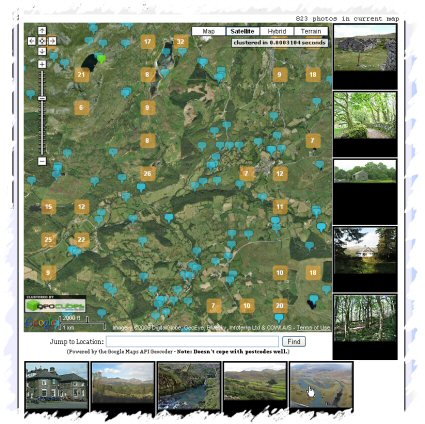
Geograph Images as you Drag - Screenshot
Quite pleased with the latest update to the Geograph Clusters Map. This displays all geograph images on a interactive draggable Google Map. The clustering is powered by Geocubes :) .

However the most exciting part of the update, is the ‘Enable Photo Display’ button. Which once clicked, enables loading a selection of thumbnails as you drag and move the map. Zoom in close enough to see many blue pins for best effect. As you move again, more images will load; the ones shown should always be within the current map view. The data to show images again comes from the Geocubes API, although we load actual thumbnails via our own API.

Pretty Map!

Sunday, September 6th, 2009

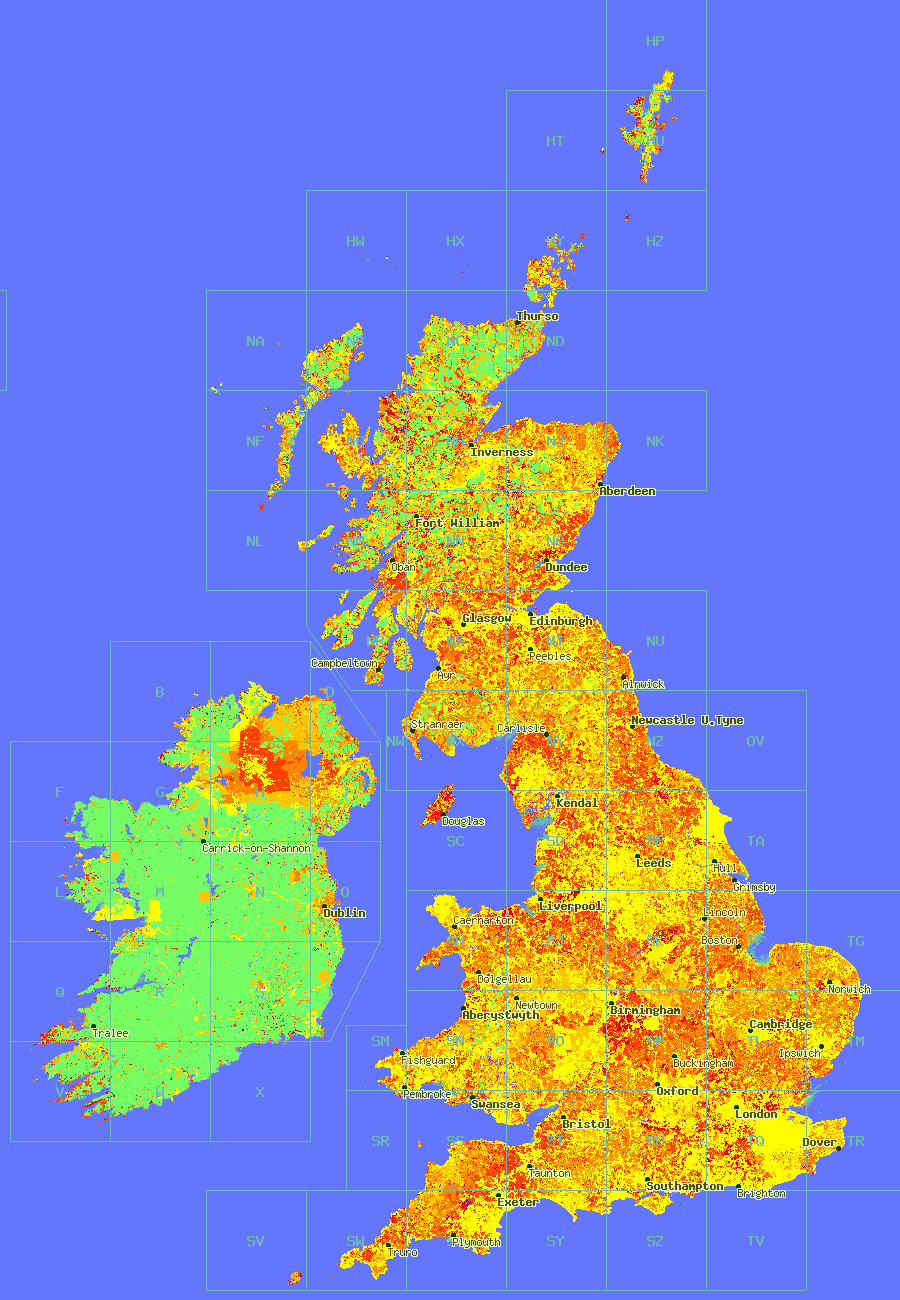
One of the things we been looking recently on Geograph, is guageing how ‘recent’ our coverage actually is. We impose no restriction on when photos where taken – because historical images are useful – not to mention every photo is historic by definition as soon as its taken!
'Age Map'
Anyway the point of this post is in the process decided to try plotting a map showing the ‘age’ of the latest photo in a square – to see that recentness. The result is here:

OMG, quite aside from what it shows, it looks beautiful. (To my untrained eye!)

Click the image for a glorious 1px per km version.

© Copyright 2009 Geograph Project and licensed for reuse under this Creative Commons Licence. (if you want to do anything with it!)

Key: Age less than in years: (0 means no photos yet)
geograph 'depth map' key

There is also a whole series of rendered maps from the project.

Scenicness Map of Great Britain

Friday, August 21st, 2009

This was made a while ago, but never really publised – so time it was given a bit more exposure…

Thanks to the thousands of people rating locations over at ScenicOrNot, and the fact those locations are tied to Geograph images, we can plot the scenicness on a map!

Screenshot of ScenicOrNot data plotted on the Geograph Interactive Mapper

ScenicOrNot based map


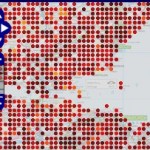
The interactive mapper on Geograph now has a ScenicOrNot layer – updated weekly. You can also use the mapper to view the projects coverage so far.
Click the thumbnail to see the map for an area just south of Edinbrough, drag the map for other areas :) . The lighter the colour the more scenic.

Geocube Geograph Clusters in Google Earth

Wednesday, July 15th, 2009

It’s about time did some Google Earth hacking, so thanks to the people at Geocubes, have made a new interactive layer for Google Earth.

Geograph Google Earth Clusters

This works in a similar way to the Geograph SuperLayer, by showing coverage overview, and then zooming in to reveal more detail. The Geocubes layer has the advantage that the clusters work into a closer zoom, and updates to the geograph database make it into the layer within hours. The SuperLayer is slower updating (weeks), but navigating should be much quicker being as its based on KML regions.

You can view also a Google Maps based version of the layer, using the Geocubes API directly.

This is only version 0.1 – there is more to be done – including being able to filter the results based on words and contributor, but this is exciting enough on its own. Once done a bit of work on tidying up the code plan to release it so others can use the geocubes service to create their own layer like this :) Watch this space!

Where in British Isles are people viewing photos?

Friday, April 24th, 2009

view-depth1-9
In a similar vain to the maps produced here, now that Geograph British Isles has a view counter for each and every photo, we can plot maps of viewing. :)

This map is obviouslly heavily influenced by where photos have actully been submitted; s for comparison here is a depth map of photo submissions.

Don’t know what it means, or if actully useful, but sure is pretty!


(click the thumbnail to see 1px per km scale version)

is it ScenicOrNot?

Saturday, April 4th, 2009

ScenicOrNot

ScenicOrNot is a new mashup from the good people at mySociety – with the simple aim of finding the scenic spots across Great Britain; I’ve no idea what the super secret purpose of this site is, but they have promised to release the data, so it could be used in lots of exciting ways… 


Oh and of course the photos are sourced from Geograph British Isles.

Go rate a grid square now! Also at http://digg.com/u18iG

Geograph Germany (quietly) launches!

Wednesday, February 18th, 2009

It’s very nearly happened a number of times before, but its now offical we have the first Geograph website for another country! 

This is the though the hard work of Hansjörg Lipp, fighting though the various land mines we have left in the open source code that powers geograph. As developers we (well mainly me – I am a lazy programmer!) have taken a number of shortcuts it just getting it to work the quickest way for us in the British Isles, so while the intention its should be easy to start another country it was never as easy as it should be.

You can see the site here:

http://geo.hlipp.de/

which will hopefully be translated fully to Germany. There is also a English language version here:

http://geo-en.hlipp.de/

which still connects to the same database :)

You can read about the experience of working with the code here :)

Its still early days for the project (it only covers a few provinces of southern Germany so far), but its really exciting to see a new site based on the Geograph concept (and code!), we wish Hansjörg Lipp and his team every success. (I wont embarrass myself trying to put any German in here!)

Ask the audience… how to promote long term seeding?

Friday, February 6th, 2009

Geograph offers bulk Torrent downloads, of images. All good (we hope!), but a major reason for doing this is to utalise the power of p2p and share the bandwidth bill. We have bordering on 150Gb of image data to share, but everybody downloading that data from our servers is, well a LOT, not to mention slow, and using bandwidth that could otherwise be serving regular visitors. (the alternative is to serve it from home – but using the upstream connection for that size is also really slow…) 

But to do this is needs others to help with the seeding – in the long term. For a while now 90% of downloading is coming from a seed I have on a server, ie people are peering while downloading, but as soon as the download is completed… its ‘thanks for the fish’ and they are gone.

(we could seed from our homes too, but with the server offering a big enough pipe theres no need – yes aware of the irony in that statement – but we already paying for the server) 

So what can be done to help encourage others to stick around and help?  One consideration is the torrents include the raw files – rather than a tar or similar, making it easy to keep the torrent software pointed at the folder that actullly use the images – without duplication. 

What if the files where made smaller?  (but would mean many more torrents – and the assumption is people are pretty much wanting most images, so picking and choosing isnt really going to happen) 

One critism is the metadata in the files, is hard to keep uptodate – the metatdata is updated on the site from time to time. But for the most part that can be considered a different issue, we can offer bulk downloads of data – on a bespoke basis. (and have an API

I’ve looked around the interweb, and this does crop up occasionally. But our case is somewhat unique; its a specialist market (so really at most 1 or 2 downloaders at once), the files on the large size, and we’er in this for the long term (decades ideally!).